|  |
|

| Missing In Action (MIA) | Prisoners Of War (POW) | Unexploded Ordnance (UXO) |
| Chronology | Locations | Aircraft | Ships | Submit Info | How You Can Help | Donate |
|
| USAAF 11th AF 343th FG 54th FS 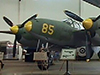 via Hill Aerospace 2001 |
Pilot 1st Lt. Arthur W. Kidder, Jr. (rescued) Force Landed February 2, 1945 MACR none Pilot History Lt. Kidder was an experienced P-38 pilot, having flown 54 combat missions on a previous tour of duty in the Mediterranean Theater of Operations (MTO) with the 96th Fighter Group (96th FG) based in Italy and four aerial victory claims: one on July 4, 1944 and three on July 8, 1944. Aircraft History Built by Lockheed Aircraft Corporation (LAC) in Burbank. Constructors Number 2149. Delivered to the U.S. Army Air Force (USAAF) as P-38J-10-LO Lightning serial number 42-67638. Wartime History During May 1944, assigned to the 11th Air Force (11th AF), 343rd Fighter Group (343rd FG), 54th Fighter Squadron (54th FS) at Attu Airfield (Alexai Point Airfield) on Attu Island. No known nose art or nickname. Nose Number 85 was painted in yellow on the left side of the nose. The propeller spinners were painted yellow. During early 1945, P-38s of the 54th Fighter Squadron began to fly special high-altitude missions to intercept Japanese balloon bombs drifting in the jet stream eastward towards North America. Attu Airfield was directly in their flight path and many balloons passed overhead at altitudes between 30,000' to 37,000'. Mission History On February 2, 1945 took off piloted by 1st Lt. Arthur W. Kidder, Jr. on a local test hop after a 50 hour inspection. The test flight was scheduled to take two hours, checking the aircraft at the extremes of its performance envelope. After the mission, Lt. Kidder radioed Attu Airfield (Alexai Point Airfield) for clearance to land and headed down through the clouds. The controller gave him a vector heading and said he was only about 15 miles from base, but when Kidder broke out of the clouds at about 1,500 feet above the Pacific there was no land in sight. He tried to radio the control tower again for further directions, but discovered that ice had formed on his primary radio's antenna wire as he had descended through the overcast, causing it to snap off. He climbed back through the clouds to try a backup line-of-sight radio, but received no reply to his calls. He again let back down through the clouds and began to search for the base, flying a rectangular search pattern and extending each side of the box by five minutes each time. For a total of four hours, Lt. Kidder searched in vain for Attu Island. Running low on fuel, he began to look for any land to force land instead of ditching into the frigid North Pacific. Finally he spotted Buldir Island and circled it looking for a suitable landing site. Only a small patch of relatively flat terrain existed on the island and he headed straight for it. Knowing that the P-38 was fairly smooth on the bottom and prone to slide great distances in belly-landings, Kidder decided to lower the gear and then retract them at the last moment, leaving the gear doors down to plow into the ground and slow his slide. This worked perfectly and the P-38 slid only 300' before coming to rest in the tall grass. With only 385 hours on its airframe, this P-38's short career came to an end. Rescue Five U.S. Army soldiers stationed at a tiny weather outpost on Buldir Island heard the crash-landing and ran to help the pilot. They informed Kidder that he had landed 100 miles east of Attu Island. They immediately began sending messages on their low-powered weather reporting radio, but since no one was expecting a report from them at that time there was no response. Later that night, a ham radio operator in St. Louis, Missouri picked up their distress calls and contacted the War Department. Two days later, a Navy patrol vessel picked up Lt. Kidder and returned him to Attu Island. Wreckage This Lightning was abandoned and used as a ground target for other P-38s performing air-to-ground gunnery training. What remained of the aircraft remained in situ on Buldir Island until August 1994. Recovery During August 1994 this aircraft was salvaged by the U.S. Air Force (USAF) 405th Combat Logistics Support Squadron with Hill Aerospace Museum (Air Force Heritage Foundation). The salvage included former pilot Arthur Kidder, then retired and living in Colorado, was located and invited to accompany Heritage Foundation members and personnel from the 405th Combat Logistics Support Squadron based at Hill AFB on the recovery expedition. Restoration & Display In October 1984, this P-38 was recovered and transported to California and rebuilt for static display repainted in in the correct wartime markings. Portions of other P-38 Lightnings recovered by Dick Odgers from Cold Bay were used in the restoration. Display In August 1996, the restored P-38 was placed on display at Hill Aerospace Museum (Air Force Heritage Foundation). References NARA World War II Army Enlistment Records - Arthur W. Kidder, Jr. USAF Serial Number Search Results - P-38J-10-LO Lightning 42-67638 "67638 crash-landed on Buldir Island, Alaska in 1944. Recovered in 1994 by Hill AFB Museum, and is now on static display there." Hill AFB - P-38 Restoration (via Wayback Machine 2007) Contribute Information Are you a relative or associated with any person mentioned? Do you have photos or additional information to add? Last Updated November 22, 2025 |
 P-38 |
| Discussion Forum | Daily Updates | Reviews | Museums | Interviews & Oral Histories |
|


