|
 |
|
|
| Missing In Action (MIA) | Prisoners Of War (POW) | Unexploded Ordnance (UXO) |
| Chronology | Locations | Aircraft | Ships | Submit Info | How You Can Help | Donate |
|
| IJN ? Kōkūtai |
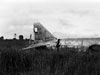
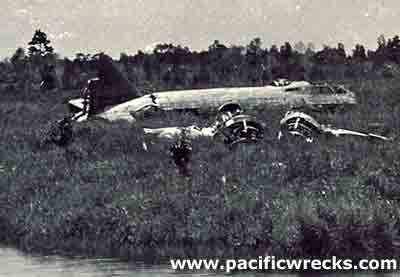
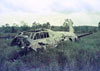
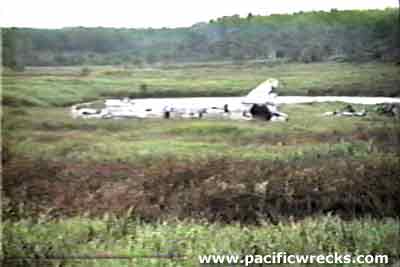
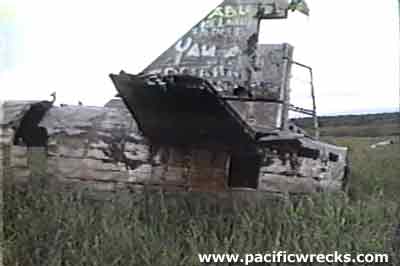
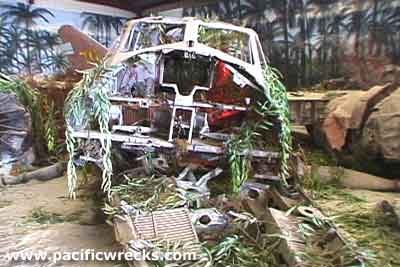
Aircraft History Built by Mitsubishi at Nagoya No. 3 Works on April 16, 1942. At the factory, painted with dark green upper surfaces and gray lower surfaces with the upper portion of the nose and inside of each engine cowling painted black. The leading edge of the wing was painted with a yellow identification stripe. The fuselage Hinomaru was outlined with a white square. Wartime History Delivered to the Imperial Japanese Navy (IJN) as Type 1 Attack Bomber / G4M1 Model 11 Betty manufacture number 1280. Assigned to an unknown Kōkūtai (Air Group). Possibly, assigned to the 761 Kōkūtai (761 Air Group). Tail code "370" and later "-321". This Betty operated from western New Guinea. The precise wartime history of this aircraft is unknown, possibly it was used as transport plane. By 1944, force landed wheels up at Babo Airfield with the left engine feathered. After the landing, the nose was crushed and likely was written off. Wreckage This Betty was abandoned at the edge of the runway at Babo Airfield. Afterwards, both wings were removed and placed near the fuselage, possibly in an attempt to repair the bomber or for spare parts. During 1944, this Betty was photographed by B-25 Mitchell from the 3rd Bomb Group during a low level strike against the airfield. By 1969, the tail section had a large gash that nearly severed the tail section, possibly an attempt to cut up the aircraft for scrap metal. Until 1991, this Betty remained in situ at Babo Airfield. Recovery During 1991, this Betty as removed by Bruce Fenstermaker. Inside the wreckage, he found an ink pen from one of the crew members, a gift for a martial arts competition. Also recovered was A6M3 Zero 3869, A6M2 Zero Tail 33, D4Y1 July 7483 and Ki-61 Tony 7?? plus other aircraft wreckage were placed into shipping containers and exported to Los Angeles. The salvaged aircraft were originally intended for the Santa Monica Museum of Flight. Unsold, this Betty was purchased by Planes of Fame Museum and transported to Chino Airfield. Display Since the early 1990s, displayed at Planes of Fame Museum unrestored in a jungle diorama in their World War II hanger. In November 2015, this aircraft was sold to Paul Allen / Flying Heritage Collection (FHC) and likely owned by his holding company, Vulcan Warbirds, Inc. This Betty was trucked from Chino, California to an unknown storage facility, likely in the Everett, Washington area. This bomber has not been publicly acknowledged by FHC or Vulcan, yet. Reportedly, the Betty will be restored. References Air'Tell Research Report "G4M Serial Numbers" by Jim Long Jim Long adds: "My friend Greg James inspected this Betty and a Judy when they arrived at the Planes of Fame Air Museum in the 1990s. I wrote a report about the identity of the Betty for Edward Maloney dated 27 October 1997, the date when I started doing the research. Greg James determined the correct MN by examining the remains of the fuselage stencil on 23 November 1997, as I requested him to do when I was preparing the report to Maloney. As a matter of fact he was able to make a life-size drawing of the stencil and some of its characters and numbers. The right portion of the stencil was clear enough to see that the top line labeled the plane as a Model 11, that the second line carried the manufacture number 1280, and that the third line carried three numerals of the date of manufacture: 2 [missing] 16. From this information and the life-size drawing supplied by James, plus my own research about serial numbers, I was able to determine that the individual plane was completed by Mitsubishi on 16 April 1942. James noted that at least part of a tail marking survived. The vertical tail carried a large marking, probably white in color, on the right side of the fin, consisting of the numerals 7 and 0. James could not see a numeral 3 preceding the 70, probably because it had weathered so badly. Even the 70 could only just be made out, but they were clear enough for James to roughly measure them. The height of the two figures was about 521.5 millimeters. The width of the 0 was about 441 mm and that of the 7 was about 419 mm. This was enough information for me to guess that the individual airplane's number was 370. There may or may not have been a unit letter or unit letter and number that preceded the 370. Many of the Bettys operating in the area carried no unit identifier for a time. The left side of the fin, where such a marking would have been was covered with paint markings put on by the salvagers. From his vantage point on the ground, James could not see any original markings on the left side of the fin, if any were there. He was not allowed to climb upon the tail section to take a closer look." Thanks to Edward Maloney, Bruce Fenstermaker and Jim Long for additional information Contribute
Information Last Updated
|
 Betty  Photo Archive |
| Discussion Forum | Daily Updates | Reviews | Museums | Interviews & Oral Histories |
|