|  |
|

| Missing In Action (MIA) | Prisoners Of War (POW) | Unexploded Ordnance (UXO) |
| Chronology | Locations | Aircraft | Ships | Submit Info | How You Can Help | Donate |
|
| USAAF 5th AF 43rd BG 63rd BS 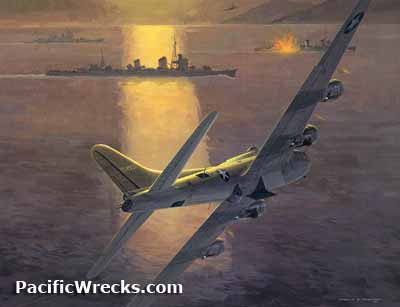 Cy Peabody, 1981  via Pride of Seattle    43rd BG 1943   63rd BS 1943  63rd BS July 1943 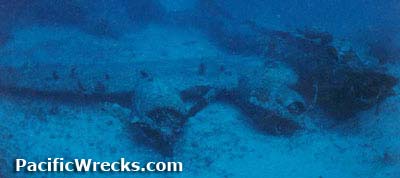  Ian Williams 1998 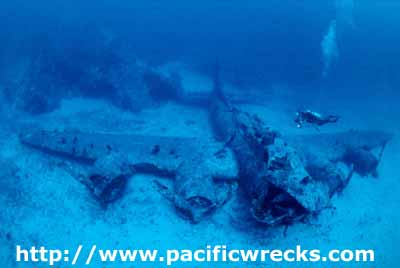 Rod Pearce 2000 |
Pilot 1st Lt Ralph K. De Loach, O-440981 (survived) St. Petersburg, FL Co-Pilot 1st Lt Joseph H. Moore, O-426411 (survived) Aliquippa, PA Navigator 1st Lt Charles H. Shaver, O-797085 (survived) Lee, MA Bombardier 2nd Lt. Herman J. Dias, O-729959 (survived) San Francisco, CA Engineer SSgt Delbert C. Smith, 39166314 (WIA, survived) Anahiem, CA Radio TSgt George Prezioso, 12009388 (survived) Belleville, NJ Ball Turret Joseph F. Wilson, 13052496 (survived) Philadelphia, PA Waist Gunner Private Daniel T. Clinton, 11037309 (survived) Brockton, MA Waist Gunner Cpl James R. Peterson, 17043264 (survived) Mason City, IA Tail Gunner SSgt Paul J. Blasewitz, 12028587 (survived) AR Ditched July 11, 1943 MACR none Aircraft History Built by Boeing at Seattle at the cost of $314,109. Constructors Number 3206. On July 23, 1943 delivered to the U.S. Army Air Force (USAF) as B-17F-20-BO Flying Fortress serial number 41-24521 flown to Lowry Field for outfitting then Hamilton Field. On August 30, 1942 this B-17 took off from Hamilton Field pilot by Lt. William O'Brien on a ferry flight via Hickam then across the Pacific to Australia. Wartime History On September 7, 1943 assigned to 5th Air Force (5th AF), 43rd Bombardment Group (43rd BG), 63rd Bombardment Squadron (63rd BS). Assigned to pilot Captain Kenneth D. McCullar with crew chief was DeAngelis. McCullar nicknamed the bomber "Black Jack" because the serial number ended in "21". The right side of the nose had the nose art of two playing cards: a jack and ace that equal 21 in the card game of blackjack. On October 15, 1942 took from 7 Mile Drome piloted by Captain McCullar as one of six B-17s flying individual reconnaissance missions over the Solomon Sea. While flying over the Shortland Islands, south of Faisi Island, McCullar spotted a "light cruiser" and decided to make a solo bombing run from 3,500' then dove down to 1,500' as bombardier 1st Lt. Robert H. Butler released their bombs. The crew claimed a direct hit and turned for home as the ship returned anti-aircraft fire and caused a hole in the right aileron but returned safely. The crew were credited with a light cruiser sunk and recommended for the Silver Star. In fact, no Japanese warship was sunk on this date or location to support this claim. On October 25, 1942 at 12:30am took from 7 Mile Drome piloted by Captain McCullar as one of seven B-17 on a bombing mission against Japanese shipping in Simpson Harbor off Rabaul. Over the target, an anti-aircraft shell exploded below then nose. Aboard, navigator 1st Lt. Kenneth W. Beckstrom and bombardier 1st Lt. Robert H. Buter were wounded by shrapnel fragments that caused them both minor head wounds. On November 24, 1942 at night took from 7 Mile Drome piloted by Captain McCullar on a mission against Japanese destroyers in Huon Gulf. On the first bomb run, this B-17 performed a skip bombing attack from 200' with bombs impacting off the stern of Hayashio. Aboard this B-17, anti-aircraft fire hit ammunition and started a fire in the tail section that was successfully extinguished. On the second bomb run, this B-17 was hit again and three crew were injured. On the third run the left outboard engine was hit and the engine did not feather and controls damaged. McCullar made two more attacks from higher altitude and the right outboard engine failed due to a hit in the fuel system. Out of bombs, they departed. On the return flight the damaged left engine's propeller broke off and spun off. Loosing altitude, the crew jettisoned all equipment possible and managed to restart the right engine and managed to climb over the Owen Stanley Range back to Port Moresby. Later that night, Royal Australian Air Force (RAAF) Beaufort crews reported a destroyer sinking. During the B-17 bombing runs, Hayashio was damaged and later scuttled. Afterwards, the damaged B-17 underwent repairs. Next, assigned to McCullar's co-pilot Lt. Harry A. Staley, until he completed his tour of duty. Staley added to the left side of the nose the nickname "The Joker's Wild" with the nose art of a large joker playing card above the pitot tube. During 1943, this B-17 was field modified by McCullar with an extra .50 caliber machine gun rigged into the nose to fire forward that was triggered from the pilot's control yoke. On February 14, 1943 took from 7 Mile Drome piloted by Lt. Harry Staley as one of 37 B-17s including 13 from 63rd BS plus 10 B-24s from 90th Bomb Group (90th BG) on a bombing mission against Rabaul. On the bomber's first bomb run, picked up by searchlights and targeted by anti-aircraft fire and hit in the no. 3 engine that severed oil lines and controls and knocked out the engine. Damaged, Staley flew away from the target, but when he realized the plane was under control turned around for a second bomb run bombing the Kokopo area. Returning in bad weather and thunderstorms, the B-17 was struck by lightning that disabled the radio receiver and damaged the electrical system. Regardless, the bomber was able to land safely at 7 Mile Drome after 7 hours 30 minutes airborne. Afterwards, the entire crew earned the Distinguished Flying Cross (DFC) for the mission. Afterwards, this B-17 underwent repair until April 1943. Afterwards, the bomber flew fourteen more missions before it was lost. On June 18, 1943 took from 7 Mile Drome piloted by Lt. Ensberg with B-17s and B-24s on a flight to Dobodura stage for a bombing mission against Rabaul. After landing, the bombardier fell ill and did not participate in the mission and returned to 7 Mile Drome. Mission History On July 11, 1943 at 12:30am took from 7 Mile Drome near Port Moresby piloted by 1st Lt. Ralph K. De Loach with co-pilot Lt Joseph H. Moore and an ad-hoc crew on a bombing mission against Rabaul. Aboard, waist gunner Private Clinton was on his first combat mission. Over the target, this B-17 developed problems with the no. 3 and no. 4 engines on the right wing but the bomb load was e successfully released over the target. Returning, this B-17 was caught in a violent storm, with the two engines on the right wing continuing to malfunction. The pilots could not hold a straight course and got lost and ran low on fuel. Since co-pilot Moore had previously ditched a B-17, DeLoach handed the controls over to him. The B-17 ditched into the sea off Cape Vogel near Kakau and the Makau Mission at Boga Boga. Fates of the Crew During the ditching, three of the crew were injured. The worst injury was SSgt Delbert C. Smith who had been seated between the two pilots and suffered a broken back. The entire crew escaped the aircraft, deployed their life rafts an were aided ashore by friendly villagers who gave them food and shelter in their village. Nearby, Australian Coastwatcher Eric Foster observed the bomber sent a radio message to Milne Bay to notify air-sea rescue about the ditching and then went to Boga Boga where the crew had already been taken ashore by natives. Rescue The next day, Seagull A2-19 arrived and evacuated the three wounded crew to Goodenough Island. Two days later, a PT boat rescued the remainder of the crew and transported them Goodenough Island where they were then flown from Vivigani Airfield back to 7 Mile Drome. Afterwards, the unhurt crew members got two weeks leave in Sydney before returning to combat duties. Afterwards, the crew earned awarded awards for their role on the July 11, 1943 mission. DeLoach and Moore earned the Silver Star. The other eight Blasewitz, Clinton, Dias, Peterson, Prezioso, Shaver, Smith and Wilson earned the Air Medal for this mission. Steve Birdsall adds: "As part of the 'Black Jack' research we found Fifth Air Force General Orders No 197, containing the Air Medal citations for Blasewitz, Clinton, Dias, Peterson, Prezioso, Shaver, Smith and Wilson. The citations state the following: 'after leaving the target, and flying through turbulent storms and rain for four hours and with fuel running low, the aircraft made a crash-landing on a beach'." Wreckage The B-17 is upright on a flat sandy bottom at a depth of 45m / 148' off a coral reef, narrowly missing deeper water where it might never have been found. The nose section was crushed from either the ditching or when the bomber impacted the bottom when it sank. After hearing stories from the locals about a large aircraft the ditched off their village, Rodney Pearce, David Pennefather and Bruce Johnson. On December 27, 1986 discovered by SCUBA diver Rodney Pearce. also present were David Pennefather and Bruce Johnson. Nearly intact, the nose is torn and crumpled from impacting the seafloor nose first. Aside from the two waist guns and radio transmitters, jettisoned prior to ditching, all other weapons and gear were still aboard. Rod Pearce recalls: "We were very excited when we found it. We had found the serial number, but did not know the history initially. I sent the serial number to to my friend Richard Leahy and informed us the history of the bomber, the most famous B-17 in the SWPA and contacted historian Steve Birdsall, who was very excited. At a later date, he proposed the idea of making the documentary Black Jack's Last Mission. I corresponded with the tail gunner, Paul Blasewitz who wrote me a lovely letter after we found the bomber. He told me when he saw the postmark of 'Lae' he just stared at the letter for days. He told me he had a Thompson Sub-machine gun aboard, but we could never find it. When the bomber ditched, he was in the radio compartment with a parachute against his back, and the Thompson on his lap. They hit the water hard and skipped once or twice, then came to rest. Water started to fill the plane he lost, then exited through the radio hatch. Also, he told me about a "Bowie" survival knife in the tail, which we found. The blade was rusted away, but the guard was there. We also found some 30 caliber ammunition in boxes in the nose. Waist gunner Jim Peterson lived in Miami, Florida when it was found. He read an article about a bomber being discovered in New Guinea. He remembered being seated next to Blasewitz when they ditched. He recalled worrying what was going to be outside - if they would be shot or eaten by locals." Memorials Dias went Missing In Action (MIA) on January 19, 1944 as bombardier aboard B-24J "Paper Doll" 42-73187 on a mission against Ambon and was killed in the crash and remains listed as Missing In Action (MIA). He earned the Air Medal and Purple Heart, posthumously. Dias is memorialized at Manila American Cemetery on the tablets of the missing. Shaver was navigator aboard B-24J "Paper Doll" 42-73187 on a mission against Ambon. He survived the crash and was was captured by the Japanese and became a Prisoner Of War (POW) until the end of the Pacific War. He earned the Purple Heart and Prisoner of War Medal. Shaver passed away on March 8, 1997 at age 77. On March 18, 1997 he was buried at Arlington National Cemetery at section 60, site 6218. Clinton passed away in February 1977 Brockton, MA. He has an unknown burial. Wilson passed away September 29, 1986 at age 65. He is buried at Brigadier General William C. Doyle Memorial Cemetery in Wrightstown, NJ in section D site 220. Smith passed away on August 18, 1992 at age 70. He is buried at Fayetteville National Cemetery in Fayetteville, AR at section 26, grave 115. Moore passed away on September 8, 1994 at age 79-80 in Aliquippa, PA. He is buried at Sylvania Hills Memorial Park in Rochester, PA in the garden of the cross. Shaver passed away on March 8, 1997 at age 77. On March 18, 1997 he was buried at Arlington National Cemetery at section 60, site 6218. Blasewitz passed away September 1, 2005 at age 88. He is buried at Bay Pines National Cemetery in Bay Pines National Cemetery in Bay Pines, FL at section 57, row 7, site 63. De Loach passed away on September 22, 2007. He has an unknown burial in the United States. Prezioso passed away on January 9, 2015 at age 95. He is buried at Mount Olivet Cemetery in Bloomfield, NJ. Peterson passed away on October 12, 2018 at age 98. He is buried at First Presbyterian Church Columbarium in Eau Claire, WI. References Note, pilot Ralph K. De Loach surname is spelled "Deloach" as one word in some sources. NARA World War II Army Enlistment Records - Ralph K. De Loach NARA World War II Army Enlistment Records - Joseph H. Moore NARA World War II Army Enlistment Records - Charles H. Shaver NARA World War II Army Enlistment Records - Herman J. Dias NARA World War II Army Enlistment Records - Delbert C. Smith NARA World War II Army Enlistment Records - George Prezioso NARA World War II Army Enlistment Records - Joseph F. Wilson NARA World War II Army Enlistment Records - Daniel T. Clinton NARA World War II Army Enlistment Records - James R. Peterson NARA World War II Army Enlistment Records - Paul J. Blasewitz USAF Serial Number Search Results - B-17F-20-BO Flying Fortress 41-24521 "24521 (63rd BS, *Black Jack--The Joker's Wild*) ditched Jul 11, 1943 during raid on Rabaul. The wreck is still down there." Fifth Air Force General Orders No 197, containing the Air Medal citations for Blasewitz, Clinton, Dias, Peterson, Prezioso, Shaver, Smith and Wilson PNG Museum Aircraft Status Card - B-17F Flying Fortress 41-24521 FindAGrave - Virtual Cemetery created by PacificWrecks.com - B-17F "Black Jack" 41-24521 FindAGrave - Ralph K De Loach (photos) FindAGrave - Joseph H Moore (grave photo) FindAGrave - Charles Henry Shaver (grave photos) Arlington National Cemetery (ANC Explorer) - Charles Henry Shaver (grave photos) FindAGrave - 1Lt Herman J Dias (tablets of the missing) American Battle Monuments Commission (ABMC) - Herman J. Dias FindAGrave - Delbert C. Smith (photo, grave photo) FindAGrave - George Prezioso (obituary) FindAGrave - Joseph F Wilson, Sr (grave photo) FindAGrave - Daniel T. Clinton [profile removed] FindAGrave - James R. Peterson (grave photo) FindAGrave - Paul J. Blasewitz (grave photo) National Geographic "Ghosts of War" (April 1988) pages 426-427 Warbirds "Black Jack's Last Mission" by Steve Birdsall Sept / Oct 1989 Winged Ghosts of the Pacific (1995) includes dive footage of the wreck Black Jack's Last Mission (1988) by Steve Birdsall Pride of Seattle (1998) pages 10-11, 15 Fortress Against The Sun (2001) page 287 (November 24, 1942) Ken's Men Against The Empire Volume I (2016) pages 60 (September 7, 1943), 68-69 (October 15, 1943), 72-73 (October 25, 1942), 89-90 (November 24, 1942), 92, 127-128 (February 14, 1943), 216 (Profile 5), 221 (Profile 5a / 5b detail), 230 (June 18, 1943), 244-246 (July 11, 1943), 325 (63rd BS, 41-24521), 337, 339 (photos Black Jack / The Joker's Wild), 341, 353-354 (Profile #5 B-17E 41-24521), 367, 386 (index Black Jack), 390 (index De Loach) Ken's Men Against The Empire Volume I (2020) pages 132 (February 14, 1943) Thanks to Rod Pearce, Steve Birdsall, George Prezioso and James R. Peterson for additional information Contribute Information Are you a relative or associated with any person mentioned? Do you have photos or additional information to add? Last Updated May 13, 2025
|
 B-17  45m / 148'  George Prezioso Paul Blasewitz Account  Black Jack's Last Mission  Photo Archive |
| Discussion Forum | Daily Updates | Reviews | Museums | Interviews & Oral Histories |
|


