|  |
|
| |
|
| Missing In Action (MIA) | Prisoners Of War (POW) | Unexploded Ordnance (UXO) |
| Chronology | Locations | Aircraft | Ships | Submit Info | How You Can Help | Donate |
|
| IJN Tainan Kōkūtai    Circa summer 1942  USAAF 1943   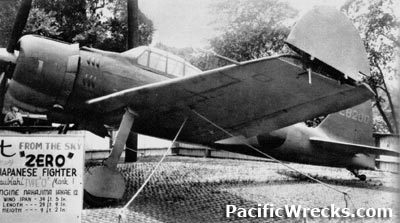  USAAF April 1944 |
Pilot Flying Petty Officer First Class Shimezoh Inoue (MIA / KIA) Force Landed November 26, 1941 Aircraft History Built by Mitsubishi on October, 21 1941. Delivered to the Imperial Japanese Navy (IJN) as A6M2 Model 21 Zero manufacture number 3372. At the factory, painted overall gray with a black cowling. Wartime History Assigned to the Tainan Kōkūtai (Tainan Air Group). Tail code V-172 painted white and outlined in red between two blue bands. The rear fuselage had a diagonal yellow stripe rear of the Hinomaru (Rising Sun). This Zero was regularly assigned to Lt. Inano. Wartime History On November 26, 1941 in the predawn darkness, took off from Tainan Airfield piloted by Flying Petty Officer 1st Class Shimezoh Inoue on a ferry flight via Hainan Island to refuel then was to continue onward to Saigon. Due to bad weather, two Zeros became separated and lost, this Zero and A6M2 Zero V-174 pilot Petty Officer 2nd Class Taka-aki Shimohigashi. Near Qian Shan (Teitsan) on the southeastern coast of Leichou Peninsula on China. Both Zeros force landed on the beach. Inoue landed successfully. Shimohigashi’s Zero was extensively damaged in the landing. Fate of the Pilot The exact fate of the pilots are unknown. Reportedly, they were captured by Chinese forces and never returned. Recovery This aircraft was the first intact Japanese A6M2 Zero captured captured as a war prize. This Zero was pulled off the beach by the Chinese, along with A6M2 Zero V-174. Both were transported inland over several months to Liuchow. Reassembled by Chinese mechanics at Liuchow Airfield. Possibily, parts were used from the other Zero. During re-assembly it was found that the fuselage panels aft of the cowling had been lost or stolen while in transit. Instead, the Chinese made replacement parts. Reportedly, General Nathan F. Twining, then Director of War Organization and Movement, went to China and was was shown the remains of this Zero and informed General Chennault. Two 76th Fighter Squadron personnel later arrived at Liuchow and inspected the Zero, and Yank photographer documented the aircraft. The Zero had been repainted with Chinese Air Force markings and the Chinese serial, P-5016. "The Zero Club" in China 75th FS C.O. pilot Alison was the first American to fly this Zero to Kweilin Airfield. It suffered a force landing due to failure of the landing gear to extend and was again repaired. Later, the Zero was flown by at least five other American pilots who called themselves “The Zero Club". In early 1943 the Zero was flown from Kunming to Karachi, India with an escort flight of 23rd Fighter Group Curtiss P-40K Warhawks. One by one, all the Warhawks aborted their escort mission and Zero 3372 arrived in Karachi alone! There, Neumann supervised the crating of the Zero and it was placed aboard a ship bound for the United States as a war prize and for further testing. Testing in USA Although it sustained some damage during transport, Curtiss Aircraft volunteered to rebuild the damaged Zero once again. After its repair and reconstruction, but now bearing USAAF markings and evaluation code EB-2 on the tail. It underwent further test flights at Wright Field, Ohio and the Army Proving Grounds at Eglin Field where the tail number was changed to EB-200. Richard Dunn adds: "A report dated 10 March 44 says that Zeke EB-200 had arrived at Wright Field with 30 hrs flying time and had flown no additional hrs since arrival." Fate of the Zero Scrapped or otherwise disposed after the war. Today, apiece of tail fabric with the serial number 3372 shown in this photograph and a metal data plate are all the only known remains of this aircraft. References War Prize: The Capture Of The First Japanese Zero Fighter In 1941 by Jim Lansdale Koku-Fan Magazine, May 1964, Vol. 13 No. 7, published by Bunrindo Co., Ltd., Tokyo, pages 28 and 30 via Jim Long Contribute Information Are you a relative or associated with any person mentioned? Do you have photos or additional information to add? Last Updated May 11, 2025 |
 Zero |
| Discussion Forum | Daily Updates | Reviews | Museums | Interviews & Oral Histories |
|